
Medfield
BILL
Born in 1945 in South Norwalk, Connecticut, Bill grew up surrounded by open fields, history, and the freedom of wide-open spaces. “We lived in a big farmhouse built around 1790,” he recalls. With a hundred acres to explore and a brook nearby, Bill wandered freely, learning independence early alongside his three older siblings. “My dad lived by example,” he remembers. “We pulled a car back on the road once, and when the man tried to pay, my dad said, ‘No. Just do the same to someone else.’ Those things stick.”
Sports and academics were both a part of Bill’s formative years. He ran cross-country and track year-round, while his older brother excelled in basketball. Academically, he describes himself as “middle of the pack,” but his curiosity and determination set the stage for his future. A natural with numbers, Bill attended Cornell University’s Agriculture School, joining a fraternity, making lifelong friends, and cheering on the hockey team during its national championship run. “I worked really hard, struggled the first year, finally figured out how to study, and from then on, it was pretty easy,” he says of his college experience.

After graduation, Bill began his career as a CPA, learning lessons that would last a lifetime. “The company I was with had very high standards. It was the only evaluation process that actually worked,” he reflects. Those skills carried him into a 30-year career with the State of New York, where he applied those same standards and work ethic.
Family has always been central to Bill’s life. Married during college, he and his wife raised a daughter and a son, now grown, and he treasures time with his grandchildren. Throughout his life, Bill has stayed grounded in community and faith. Whether through church, local service, or simple acts of kindness, giving back has been a guiding principle.
“Be true to yourself… we’re not islands. We live in community.”
BRUCE
Born in 1957 in Detroit, Michigan, Bruce grew up in a family that valued responsibility, hard work, and togetherness. As the oldest of three siblings, he learned early lessons in leadership, patience, and navigating family dynamics. “My little brother was annoying,” he laughs, “he still wants to get into a fight with me and beat me up even though we’re adults.” Through playful rivalries, shared memories, and enduring bonds, Bruce’s childhood was full of both challenge and connection.
Sports and curiosity defined his youth. Whether playing football in the backyard or excelling at bowling, he thrived on competition and creativity. His fascination with the universe and the mechanics of how things worked guided him toward physics, a subject that captured his imagination and encouraged him to think beyond the ordinary. “I would think about stars, constellations… the fact that we’re spinning through space. It’s pretty wild when you think about it,” he recalls.

Though his family had hoped he would pursue medicine, Bruce followed his own path, drawn to people, teamwork, and problem-solving. He eventually found his calling in energy management, where he now leads as CEO of a startup focused on battery storage, grid management, and renewable energy solutions. “Technology got us into this mess,” he reflects. “And it’ll get us out.” His work bridges innovation and responsibility, always with an eye toward the future.
Family and resilience have remained central to Bruce’s life. Marrying young and relocating from Michigan to the East Coast, he navigated new cities, careers, and parenthood with determination. He credits communication, compromise, and leaving ego at the door as the keys to a strong marriage: “It’s not always about being right.” Even the most frightening experiences, like holding his daughter after a serious accident, reinforced his belief in perseverance and faith.
Outside of work, Bruce stays grounded through sports, reading, and competitive games with friends, embracing moments of joy and camaraderie. Life lessons—like forgiveness, optimism tempered with realism, and taking care of what matters—guide his everyday choices.
"You don’t know what you don’t know… life can give you curveballs. Don’t get down on yourself. Just keep going, and good things will happen."
CHRISTINE
Born in 1950, in Natick, Massachusetts, Christine grew up as the eldest of four in a household that was anything but ordinary. With two sisters who were “hell on wheels” and a brother she stayed close to, Christine navigated a childhood full of challenges, independence, and self-reliance. She fondly remembers the freedom of her neighborhood, where every day after breakfast meant bikes, swim ponds, and endless outdoor adventures: “You got up, had breakfast, and you were gone for the day.”
As a teenager, Christine worked diligently to support herself and pursue her passions. From long days at Super Duper to hairdressing school in Boston, she learned the value of hard work, independence, and perseverance. Balancing jobs and responsibilities, she also faced the heartbreak of lost love, as the man she considered her soulmate “up and joined the service without even asking me,” reshaping her dreams and forging resilience. Christine went on to raise two children on her own, always prioritizing their well-being and ensuring they had what they needed. “I went without, you know, to give them what they needed,” she recalls. Friends and family provided vital support, and she cultivated a household rich with love, care, and guidance—very differently from her own upbringing.

Travel and exploration have been central to Christine’s outlook on life. She encourages the next generation to see the world: “One thing I always say—travel, travel. Don’t stop your life here… Save some money, go someplace. Just see new things.” Family remains at the heart of her life, especially as a grandparent. She treasures every opportunity to connect with her grandchildren, often reminding them: “I only have so many minutes left in my life. So you don’t ignore me right now.”
Christine’s journey reflects a life of perseverance, adaptability, and love—lessons she hopes to pass on through her words and example.
“Keep moving forward. Don’t let the past drag you down. Just think positive—that’s how you make life work.”
DARLENE
Born and raised in a close-knit household, Darlene grew up surrounded by family—her parents, older brother, grandfather, and aunt all under one roof. “There were always adults around,” she recalls with a laugh. “My aunt wasn’t too eager to dole out punishments, but my grandfather certainly didn’t hesitate. You did not make him upset.”
Saturdays were her favorite days, spent shopping and laughing with her aunt, while Saturday nights meant game night with the family—Monopoly matches that stretched late into the night. “It was an average childhood,” she says, “but full of love and fun.”
School, on the other hand, was more a responsibility than a passion. “I went because I had to,” she admits. After trying college twice and realizing it wasn’t the right path, Darlene decided to enter the workforce. Her early jobs taught her more about life than any classroom could—starting at Shaw’s at sixteen, then at Zayre’s. Both experiences were rocky. “They weren’t very understanding,” she says. “But that’s where I learned how to be a people person.”

Diplomacy became one of her strongest skills, learning how to stay calm, kind, and respectful, even when others weren’t. “You can’t just tell someone they’re wrong,” she explains. “You say, ‘Let me check it out.’ People respond to respect.”
Life, of course, brought its share of challenges. One of the hardest periods came when her husband developed a severe reaction to an antibiotic. “He wasn’t himself,” Darlene recalls. “I kept telling the doctors something they gave him caused this, but they wouldn’t listen.” For nearly a month, she fought to be heard. “After almost a month, they finally took him off the medication—and within two days, he was starting to be himself again.” It was a moment that tested her strength and taught her the importance of persistence and advocacy. “You have to keep speaking up for the people you love,” she says.
Her daughter, Abby, now 25, is her pride and joy. “She has autism,” Darlene shares softly. “So I had to parent differently, more gently.” Instead of punishment, Darlene led with empathy and conversation. “I’d sit down and talk with her, try to understand how she was thinking and feeling.” With her mother also living in the home, it became, as Darlene says, “a village effort,” filled with patience, compassion, and understanding.
“You have to keep trying... even when it’s hard. Especially when it’s hard.”
GEORGE
Born in 1946 in New York City, George grew up in a household grounded in discipline, faith, and academic curiosity. With an older brother close in age, he navigated childhood alongside a sibling who challenged him and pushed him to grow. “A problem I had in my youth is he’s four years older than me, but we were only three years apart in school,” he recalls with a chuckle.
George’s formative years were marked by structure and a love of learning. Close to his elementary school in Queens, he walked to school each day, often returning home for lunch. He developed a strong affinity for mathematics and history, finding in numbers a form of reasoning and in history a lens on the human story. “I view mathematics as kind of a humanities course,” he explains, reflecting on how logic and human thought intertwined in his mind.

After graduate school, he worked for the Navy in Washington, D.C., and later pursued a career in actuarial work and consulting. “I had to find the striking balance between altruism, which I was brought up with, and trying to get ahead,” he says, describing how he navigated career choices with thoughtfulness and integrity.
Family and relationships have remained central to George’s life. Meeting his wife while both were starting their professional lives, George learned early on the value of patience, listening, and shared values. “You don’t want to be exactly the same, but I do think we listen to each other,” he says. Together, they adopted children and built a life centered on care, understanding, and mutual respect.
Even in retirement, George’s thirst for knowledge continues. Lifelong learning keeps his mind engaged as he studies history and literature, finding joy in both intellectual exploration and community. He appreciates the balance of work, relationships, and personal interests: “Having good relationships with people, with your family, with your friends… being stimulated—that’s what makes life meaningful.”
Since moving to Medfield in 1987, George has embraced the town’s accessibility, its people, and its geography, enjoying the proximity to beaches, mountains, and even New York City.
“Be adaptable, pursue what you enjoy, and nurture the relationships that matter.”
JAMES (JIM)
Born in Nyack, New York in 1947, Jim grew up in the kind of neighborhood kids today only hear about—where stepping outside meant finding “two dozen kids of similar age” ready to play. Childhood was filled with adventure and simple joys, from endless bike rides to wild games of “Murderball,” a no-rules mix of teamwork and chaos where “you just had to try hard.”
“My father was very much a personal responsibility person,” he says. His mother stayed home to raise the family, providing the warmth and structure that grounded his early years. Jim also remembers his maternal grandmother as an important influence—someone who added her quiet wisdom to the mix.

School didn’t come easily at first. “I almost failed first grade because I had trouble reading,” he recalls. But his parents made the bold decision to move to a town with better schools—a change that made all the difference. “That worked to improve the situation,” he says, “and I graduated with honors and a merit scholarship.”
After high school, Jim earned an engineering science degree from the State University of New York at Stony Brook. Just as he was graduating, life took an unexpected turn: he was drafted into the Army during the Vietnam War. “I had to decide—would I go for two years or add an extra year and get the position of choice? It was probably the toughest decision I ever made.” He chose to extend his service and spent three years in the Army Signal Corps, stationed overseas.
Returning home, Jim began a new chapter—marriage, family, and the responsibilities that come with both. “The hardest period was after I got married but was still overseas,” he reflects. “That was a difficult time.” Yet, as with so many of his life’s challenges, he met it with quiet perseverance.
Today, Jim’s focus has shifted from personal goals to global ones. A passionate advocate for environmental awareness, he says, “I’m worried about the lives of my grandkids twenty or thirty years from now. I want to support efforts to do something about climate change.”
“Work hard, stay humble, and remember—you’re probably more fortunate than a lot of people.”
JOHN
Born in 1962 in Jacksonville, Florida, John grew up as the youngest of five in a household guided by faith and the golden rule: “Do to others as you would have them do to you.” Raised by a single mother, he learned early the importance of kindness, perseverance, and the value of relationships. High school became a turning point when John realized he was destined to attend college—a path no one in his family had taken before. “It kind of changed my trajectory,” he recalls, crediting older friends and a mentorship through Big Brother, Big Sisters for shaping his ambitions.
John’s journey through higher education was far from easy. He navigated college life far from home, financially independent, and balancing multiple jobs to pay his way. “Most of the time, I worked three or four jobs,” he says, reflecting on the determination that would define his adulthood. His hard work paid off, earning him a degree in finance and French from UConn, after which life took a new turn through love: he met his wife in the dorms, and together they built a partnership that would span decades.

Family and relationships remain central to John’s life. With two children, he emphasizes empowerment and encouragement, reflecting on how different expectations—college as a given for his children, a surprise for him—shaped their growth. A strong marriage, he believes, relies on “communication… being honest with each other… and a lot of luck.”
Throughout his life, John has navigated both personal and global challenges. Living near the base of the Hancock Tower on 9/11, he recalls the fear of being in a vulnerable place: “I went to the Back Bay train station… There was no one there. It made me realize that the world can be a scary place.” Yet these experiences deepened his gratitude for relationships, perspective, and resilience.
Now, John finds meaning in the bonds he shares with his family and friends. He cherishes connection, understanding, and generosity: “When you’re blessed, recognize it, and be grateful.” For younger generations, his advice is simple and powerful: “Stay in school. Get an education. And… try to learn broadly while you’re young, so you can find your passion.”
“Keep an open mind. Be kind to others. ”
JOYCE
Born in Norwood in 1948, Joyce remembers her childhood as warm and full of friendship. Growing up with two brothers and a sister, she recalls a home where family came first and kindness was expected. “My parents taught me how to be a good person—not to steal or do wrong things. A lot of values,” she says. Those early lessons in honesty and respect shaped the way she’s lived her life ever since.
School, however, wasn’t her favorite place. “I hated school,” she admits with a laugh, “but I was always in the top divisions, so I was bright.” Despite her dislike for it, Joyce’s determination carried her through graduation and later to Northeastern University’s night program, where she earned a degree in accounting—proof that perseverance can outweigh passion.
As a child, she was spirited and social. “I got in trouble all the time—for talking,” she recalls fondly. Sports gave her an outlet for her energy; she played on the softball team and loved being part of a group. One of her most vivid memories is seeing John F. Kennedy as a young girl. “I was maybe five or six years old, and I saw John Kennedy in a parade running for Senate. It was the electricity in the air that I’ll always remember.”
Work came early for Joyce, who balanced classes and jobs. Her first position was in an office on the Boston Fish Pier, where she began her career in accounting. “All of my classes were mentors,” she says, reflecting on how education and experience intertwined to guide her professional journey.
Through it all, family remained at the heart of Joyce’s life. “Family,” she says simply, when asked what life has taught her most. It’s clear in her words and demeanor that love, loyalty, and hard work have been her compass.
“Be a good person. Work hard, and have good work ethics.”
KENNETH (KEN)
Born and raised in Massachusetts, Ken spent his early years surrounded by family, neighbors, and the simple joys of small-town life. “I was born in Washington, Massachusetts,” he recalls. “We lived in Watertown for a while, and then my folks bought a little house in Arlington. That was a great time.”
Ken grew up with one sister—four years older—who, as he laughs, “thought she was my second mother.” Childhood was filled with baseball games, hockey, and long afternoons spent reading or drawing. School came easily to him. “I liked math,” he says. “Didn’t like English so much.”


When Ken was just eleven, his father passed away, a moment that changed everything. “After that, I had a lot of work to do. I was told I was the man of the house,” he remembers. He took on paper routes, mowed lawns, washed windows, and even worked in his uncle’s warehouse unloading freight. That early sense of responsibility shaped the rest of his life.
After high school, Ken made one of his most defining choices: to serve his country. “The day I joined the Marine Corps—that was one of the crowning moments of my life,” he says proudly. “Probably four of the best years of my life.” Though his mother had urged him to go to college first, Ken went on to prove himself as an officer candidate, earning discipline, pride, and purpose.
Ken later married and built a life rooted in love and balance. “I was 33 when I got married,” he says. “My wife was a nurse, but she stayed home to raise our two kids. They turned out to be great kids.” The family moved to Medfield in 1975, where they found community and stability—a place to grow and give back.
Now 87, Ken still begins each day with a visit to the senior center. “I come over every morning for a cup of coffee,” he says with a smile. But it’s his compassion that truly defines him. After his wife passed away, Ken began visiting an old friend named Gino at a local care home—the same place his wife had stayed. “I go visit him every day,” Ken says. “It makes me feel good. I think it helps them, too.”
“Be nice to everybody... It guides you in the right direction.”

MARY
Born in 1943, Mary grew up in a traditional Irish family where values like kindness, faith, and perseverance guided her from an early age. School quickly became a central part of her life—a place not just for learning, but for growing. She went on to earn both her bachelor’s and master’s degrees from Bridgewater State and continued her education far beyond that, completing over seventy-five semester hours of graduate work at colleges across New England. “I’ve been to a number of schools,” she says with a smile. “Rhode Island College, UNH, Worcester State, Fitchburg State, BU—you name it.”
Mary began her career teaching social studies at South Junior High School in Brockton—the same school she had attended as a student years earlier. “The first year that school opened in ’55, I was in the eighth grade,” she recalls. “Mr. Pease hired me back after my student teaching.”

Though she loved teaching, Mary soon realized her heart was in helping students beyond the classroom. “I saw youngsters that needed help,” she explains. That realization led her to pursue a master’s in guidance and counseling.
As a guidance counselor, Mary became known for her compassion and steady wisdom. She believes that real education goes far beyond academics; it’s about building character and self-worth. “Love yourself,” she says firmly. “You can’t love anybody else unless you care about yourself first.”
Mary raised two daughters and reflects often on how different their world was from the one she grew up in. “It’s a whole different world,” she says thoughtfully, but her approach to life remains steady: to meet change with openness and grace.
At the heart of Mary’s philosophy is kindness. Inspired by Father Greg Boyle, a Jesuit known for his work with gangs in California, she carries two simple but powerful principles:
“Treat everybody equally... Everybody is good.”
NANCY
Born and raised in Somerville, Massachusetts, Nancy’s early life was shaped by both hardship and hope. Her father was killed in World War II just before it ended, leaving her to be raised by her mother and grandparents. Yet, even from a young age, Nancy carried an unshakable lightness. “I’m basically a happy person,” she says. “I like people.”
Books became her first love. “The library was my friend,” she recalls with a smile. “I’d go, get three or four books, read them all, then go back for more.” Somerville’s grand library was her second home—a world filled not just with books but records, performances, and inspiration. Through those afternoons surrounded by stories and music, Nancy discovered her passion for movement and self-expression. “A lot of what I do came from that. I learned dance language—and I’m not averse to changing things up a little.”

RICHARD (DICK)
Born in 1941, in Pittsfield, Massachusetts, Richard “Dick” grew up in a small, close-knit neighborhood that reflected the American immigrant story. His father was an Italian immigrant, and his mother was the daughter of Italian immigrants — a background that shaped his values from an early age. “They pretty much taught us to have respect for people,” he said. “Especially respect for the elderly, for authority, and to work hard all your life.”
Dick’s childhood home was modest — the first floor of a two-room house he shared with his parents and younger brother. “We shared a bedroom out of necessity,” he said, laughing. “We didn’t get along that well.” Still, the environment around him was rich with community and culture. “The thing I remember most,” he said, “is how ethnic the neighborhood was.”
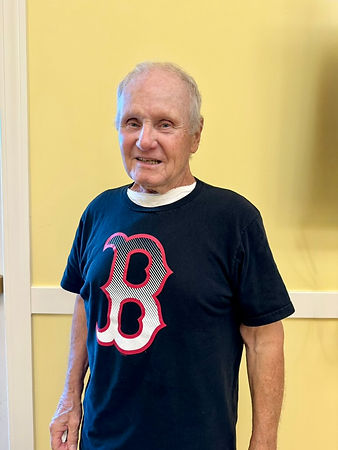
In school, Dick excelled in math and discovered his lifelong passion for baseball. “Baseball was my sport,” he said simply. Even now, he can recall the friendships formed in those elementary years, some that still last today. Back then, classrooms were strict and formal. “Teachers weren’t buddy-buddy with students,” he said. “They were the teacher, you were the student, and that was that.”
As a teenager, Dick’s life revolved around baseball, part-time work, and the rhythms of 1950s America. “We lived pretty simple lives back then,” he said. “Those old movies with rock and roll and soda shops? I lived that.” Like many young men of his time, Dick learned the value of hard work early on. From digging ditches on construction sites to working as a lab technician for a company that made papermaking equipment, he took whatever work he could find.
After high school, Dick went on to college — first in Maine, and later at Northeastern University, where he earned a master’s degree in business. The transition from high school to college was challenging, but he persevered. “It was a little bit of a struggle,” he admitted, “but it was worth it.”
Now, looking back, Dick marvels at how much the world has changed — especially technology. “It’s mind-boggling,” he said. “When I was growing up, a telephone was shared between houses. Now, you carry one in your pocket.”
“We lived pretty simple lives back then… but we were thankful for everything we had.”
SHIRLEY
Born in Framingham, Massachusetts, Shirley grew up in a large, lively household as the second oldest of six children. Her parents were strict but loving, teaching morals, respect, and the importance of treating others well. “Back then, you had to really go by the rules,” she recalls, “but they taught us how to treat people—and that stuck with me.” Shirley’s childhood was filled with family dinners, church outings with her grandmother, and joyful gatherings at civic centers where music and community shaped her early years.
School was a mix of joys and challenges. Shirley loved elementary school and had a passion for English, though math was never her favorite. Outside the classroom, she enjoyed time with friends, watching American Bandstand, and simply hanging out—cherishing the small, meaningful moments of teenage life. Shirley focused on living fully and learning as much as she could from each experience.

After high school, Shirley married young and began a life marked by both independence and perseverance. She worked in retail and factories, supporting herself and later raising two children largely on her own. She navigated the challenges of single parenthood with determination, always striving to maintain stability and normalcy for her family. “The divorces were hard,” she admits, “but we kept busy, and we made it work.” Her philosophy on partnership and relationships emphasizes communication and understanding: “If you don’t let people know how you’re feeling, they won’t have any clue.”
Later in life, Shirley returned to education, taking a customer service course at age 58 that helped her re-enter the workforce. Today, she enjoys a rich community life, spending time crocheting, reading, and socializing with friends at clubs and gatherings. Family remains central, and she believes in the importance of kindness, awareness, and supporting others whenever possible. “Just try to live your life as best you can,” she advises, reflecting her thoughtful, caring approach to the world.
Through every stage of her life—from childhood to parenthood to community involvement—Shirley’s resilience, warmth, and practical wisdom shine through. She continues to inspire those around her with her grounded perspective and generosity of spirit.
“Just try to live your life as best you can, and be kind to yourself and others.”
ANONYMOUS
Born in Boston, Massachusetts in 1943, he grew up in a home filled with warmth, family, and the steady hum of saws and hammers from his grandfather’s carpentry work. The old Victorian house they lived in had once belonged to the well-to-do—but by the time he came along, it was a cozy two-family home where three generations lived under one roof. “My mother and father and sister and I lived on one floor, and my grandparents lived on the other,” he recalls fondly. “I was very close to my grandmother and grandfather.”
He started in parochial school—disciplined, structured, and a little ahead of the curve. But when he convinced his mom to let him transfer to Boston Public, things changed. “That was the worst mistake I made,” he laughs. “Boston Public was years behind where I was.” He became a self-proclaimed “daydreamer,” coasting through his classes and spending more time thinking about life than textbooks. Still, he graduated from Dorchester High in 1960 and, soon after, decided to trade lectures for adventure.

“I went to college for a year until I decided I already knew everything,” he says with a grin. That bold decision led him to join the Air Force, where he spent four years serving his country—and, more importantly, shaping his sense of discipline, purpose, and independence.
After his service, life took a new turn. He met his future wife, a nursing student, and together they built a life defined by perseverance and partnership. “We didn’t have a lot,” he admits. “We were kind of scrimping and saving. But eventually things got comfortable, and we moved to Medfield.” That was nearly half a century ago, and he still remembers when “you could get across town without any problem.” Now, he jokes, “I’m a grumpy old man. Every time I drive through, there’s always a bunch of school kids tying up the intersections.”
He and his wife raised three sons, and fatherhood became his proudest legacy. From coaching youth sports to leading Cub Scouts, he poured his energy into helping kids grow and discover their strengths. “If I had to leave anything for posterity,” he says, “that would be it—supporting and being involved in their lives.”
“Don’t make too many rash decisions. What you think you want in high school might not be what makes you happy later.”
ANONYMOUS
Born in Massachusetts in 1931, she grew up as the only girl with two older brothers in a home full of love and ordinary joys. Childhood memories sparkle with afternoons spent playing house and dolls with her next-door neighbor, and the quiet pleasures of school, where English quickly became her favorite subject. “I always liked English,” she remembers, a small detail that shaped a lifelong appreciation for learning.
After finishing school, she stepped into the working world as a bookkeeper in an auto body shop, embracing responsibility with quiet determination. Later, marriage brought new challenges and joys. She became a mother to her own child while also caring for four stepchildren, learning the delicate balance of patience, guidance, and love. “I enjoyed it,” she reflects simply, but it’s clear that her devotion and warmth created a family full of laughter, care, and resilience. Over the years, that family expanded to include six grandchildren and seven great-grandchildren, each carrying forward her values and example.
Her first home as an adult was a small Boston apartment, later replaced by a family house filled with memories and community. Life wasn’t without difficulties, but she approached every challenge with grace, taking each responsibility in stride.
For her, life’s meaning has always been found in relationships, family, and connection. Friends and loved ones remember her not for grand gestures, but for the joy she found in people and the quiet strength she carried through every stage of life.
“Even though it’s not of interest, learn it anyway, because you never know what life is going to bring you.”